Engineering the Digital Infrastructure of Modern Healthcare
Building systems that manage sensitive patient data while aligning with regional data protection standards, enabling healthcare providers to scale operations without compromising compliance or performance.

Healthcare systems operate under strict clinical and regulatory requirements
Hospitals, healthcare providers, and digital health platforms must manage complex patient journeys, large volumes of sensitive data, and tightly regulated operational environments.
Common operating conditions
- Highly sensitive patient and medical data
- Complex multi-department clinical workflows
- Strict compliance and data protection regulations
- Fragmented healthcare systems across providers
- Increasing demand for digital patient services

Operational challenges across healthcare organizations
Despite rapid digital adoption, many healthcare organizations still struggle with fragmented systems and inefficient clinical workflows.
Common challenges
- Patient data scattered across multiple systems
- Manual administrative processes that slow care delivery
- Limited real-time visibility into clinical operations
- Difficulty integrating medical systems and digital platforms
- Growing pressure to improve patient experience and efficiency


Core digital capabilities for modern healthcare systems
We design platforms that help healthcare organizations streamline clinical workflows, manage healthcare data securely, and enable intelligent decision support.
Digital systems that coordinate patient journeys and support hospital operations.
Typical use cases
- Patient intake and triage systems
- Appointment and scheduling platforms
- Case management for clinical teams
- Care coordination workflows
Operational focus
Efficiency, traceability, and care coordination
Secure data infrastructures that unify clinical, operational, and administrative healthcare data.
Typical use cases
- Unified patient data systems
- Medical data integration across departments
- Healthcare analytics platforms
- AI-ready clinical datasets
Operational focus
Data integrity, accessibility, and privacy protection
AI-powered systems that process and analyze healthcare documents and records.
Typical use cases
- Medical record extraction
- Automated document classification
- Clinical documentation analysis
- Healthcare claims validation
Operational focus
Accuracy, speed, and reduced administrative workload
AI-assisted tools that help clinicians and healthcare administrators make better-informed decisions.
Typical use cases
- Diagnostic support tools
- Risk prediction systems
- Treatment recommendation assistance
- Operational planning insights
Operational focus
Human-in-the-loop intelligence and explainability
Integration layers connecting hospital systems, diagnostic tools, and digital health platforms.
Typical use cases
- EHR / EMR system integration
- Laboratory and diagnostic system connectivity
- Telehealth platform integration
- Cross-provider data exchange
Operational focus
Interoperability and operational continuity
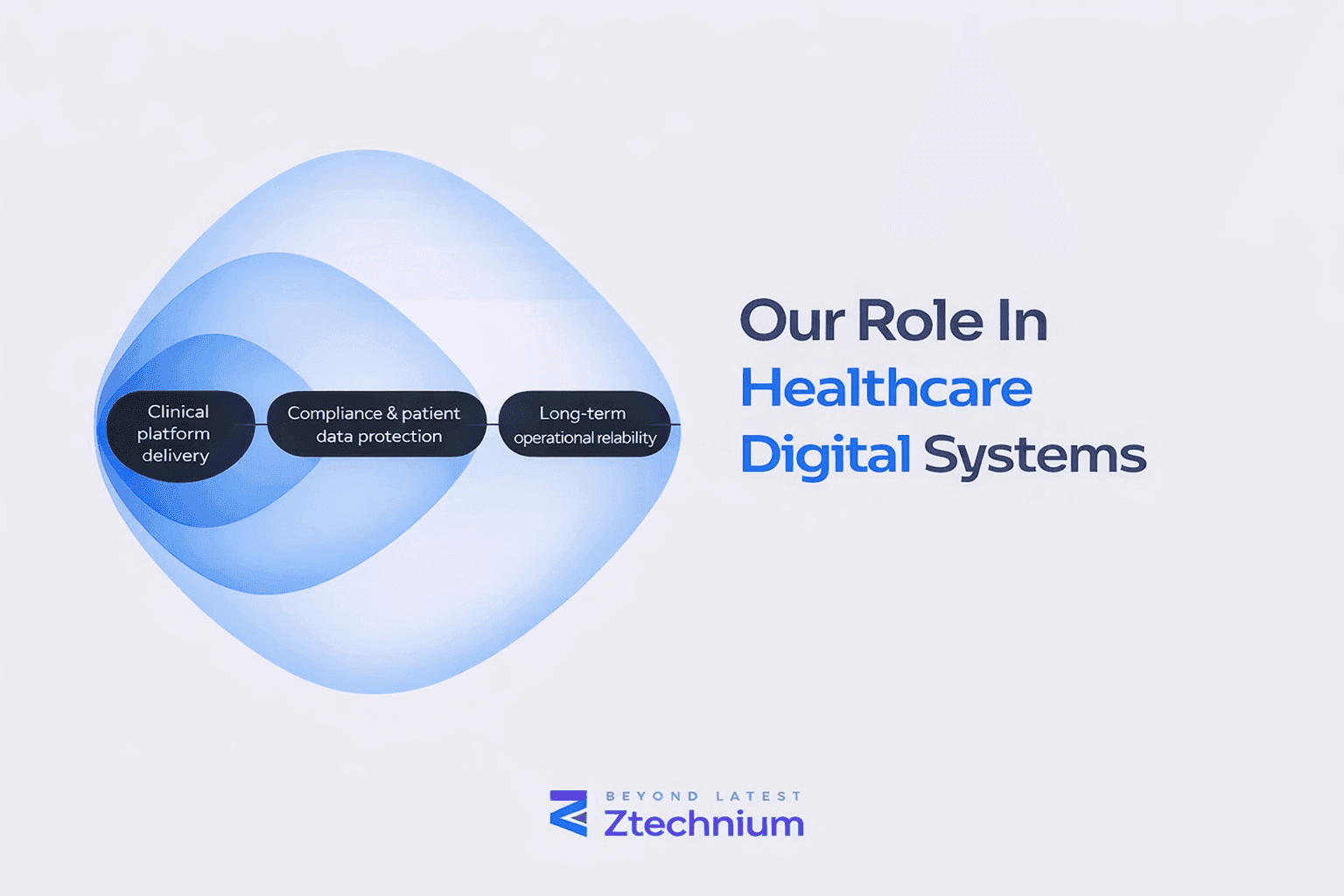
Delivering healthcare platforms that organizations can trust
Healthcare platforms must combine clinical reliability, data security, and operational stability while enabling innovation in patient services.
Delivery principles
- Security-first architecture for healthcare data
- Compliance with healthcare data protection standards
- Reliable systems for mission-critical clinical operations
- Scalable platforms that support long-term digital health strategies
Operational outcomes for healthcare organizations
Digital healthcare platforms enable hospitals and health organizations to improve both patient services and operational efficiency.
- Faster and more coordinated patient workflows
- Reduced administrative burden for medical staff
- Improved visibility into healthcare operations
- Better use of healthcare data for decision-making
- Scalable digital services for patients and providers








Explore how digital platforms can improve healthcare operations
Let’s discuss how modern digital systems can support clinical workflows, healthcare data management, and patient services.